Six core beliefs behind everything we build.
Every product decision, every line of copy, every refusal traces back to one of these beliefs. If it doesn't, it doesn't ship.
We are building Teracrowd to help organizations understand people at scale, starting with hiring and extending far beyond it.
For as long as either of us can remember, we've been fascinated by the same question: why do some teams achieve extraordinary things while others, with equally talented people, never quite find their rhythm?
We arrived at that question from different directions. Epi spent two decades building communities and crowdsourcing movements, watching ordinary people create extraordinary outcomes when the right conditions existed. Valer spent thirteen years building and scaling a company, seeing firsthand how growth succeeds or fails based on how well people understand one another.
Again and again, we observed the same pattern. The difference was rarely talent. It was alignment. The teams that moved fastest weren't necessarily smarter, more experienced, or better funded. They simply had fewer misunderstandings, less hidden friction, and a clearer understanding of one another.
Eventually, one realization became impossible to ignore: the world does not have a talent problem. It has a conversation problem.
When the right conversations don't happen, assumptions take their place. Context gets lost. Alignment becomes fragile. Small misunderstandings compound into costly decisions. The friction is often invisible until the results show up.
We're building Teracrowd to fix that. We start with hiring because it's where some of the most important conversations never happen. But hiring is only the beginning.
Read Epi's story →Every product decision, every line of copy, every refusal traces back to one of these beliefs. If it doesn't, it doesn't ship.
The world doesn't need another personality test, job board, or AI resume tool. It already has them, and they've mostly made the problem worse by scaling noise instead of understanding.
What's missing is a way to actually see people: how they work, what they want, and where they thrive. A resume can't do that. A conversation can.
Hiring is where this failure is most expensive, so that's where we start. But the real shift is bigger: from hiring to how organizations can learn to listen.
That is the company we're building. In that order.

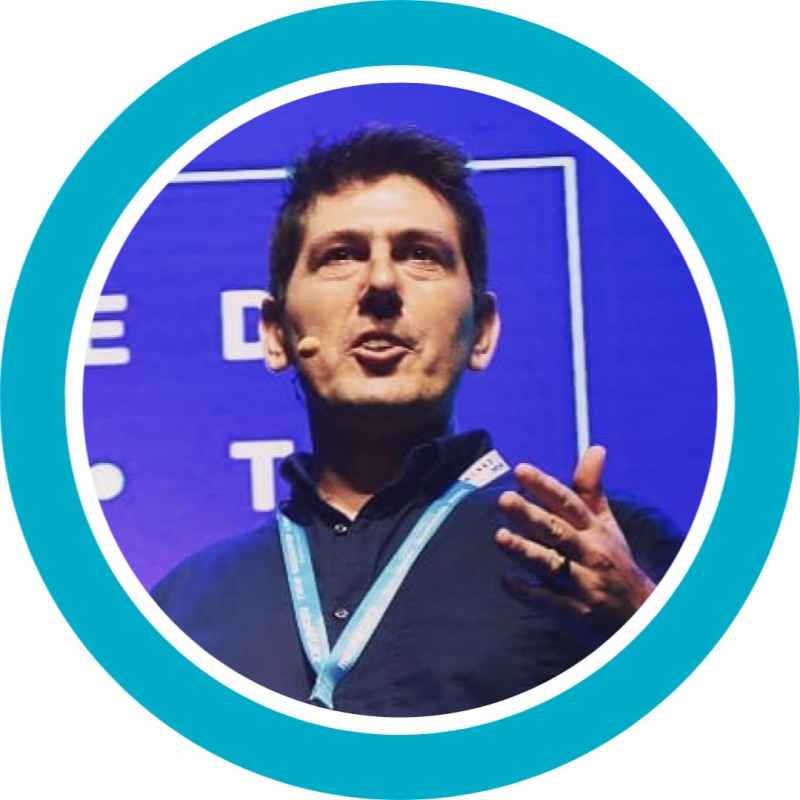
Spent thirteen years building Aladini, one of Albania's first e-commerce companies, growing it from nine people to forty and beyond. He sold it, bought it back, ran it through COVID, and stepped away in 2025. Since then, he has kept returning to the same question: how people work at scale, after watching the answer disappear as the company grew.

Two decades inside crowdsourcing and community building, watching ordinary people do extraordinary work when the right conditions are in place. Built global networks around what becomes possible when collective intelligence is given the right environment. His vision for Teracrowd is to make those conditions the default, not the exception.
We are intentionally small. Every person on the team has a clear role and the authority to execute it. No layers. No filler.

Builds systems that listen to people at scale. Believes every conversation has a structure if you ask the right follow-up question.
Work Profile
Designs every surface Teracrowd shows the world. Holds the line on the three-second rule: if a visitor cannot understand the page in three seconds, the design has failed before the copy was ever read.

Keeps every conversation, customer, and founder moving in the same direction. The first to notice when something starts to drift — and the first to name it before it becomes a pattern. Assisted, of course, by Tera.
Work ProfileSaying yes to everything is a fast way to stand for nothing. These are the moves we have already taken off the table.
There are two forces shaping work right now, and both are moving against the individual.
The first is the noise AI has poured into hiring. Two years ago, there was no such thing as a perfect resume generated in thirty seconds. No interview answer rehearsed by a chatbot. No screening system that automates the wrong process at scale. Today, all three exist — and all three reinforce the same assumption: that a person can be reduced to paper, then passed through systems that flatten them further. The noise is growing louder, cheaper, and faster.
The second force is slower, but heavier. The institutions most responsible for hiring at scale — enterprises, HR systems, and a century-old recruiting industry — cannot move at the speed the world is changing. Large organizations cannot shift in months. Meanwhile, an entire generation is entering work already convinced that work, as designed, does not work for them. The gap between how people want to work and how companies are structured to hire them widens every quarter.
So we are building from the other end. Small companies first, because they can still hear us. Real customers, because feedback is faster than belief. Real conversations with real candidates, because that is the only place where signal survives.
We do not yet have every answer. What we have is a process — listen, build, ship, listen again — and a refusal to pretend any of the steps are optional. The product is not finished. The thesis is. Everything we build serves one belief: we have not yet unlocked the full power of human collaboration, and what stands between us and it is still largely invisible.
If you speak to us this year, you will find a company that is clear about what it is fighting, and honest about what it is still learning. That is not uncertainty. That is the work.
No credit card. Run your next hire through Tera. The fastest way to know whether any of this is true is to use it.
Start free →Customer stories, founder reflections, and what we are noticing as the noise grows louder. Long-form thinking, no marketing.
Read our signal →Founder, recruiter, candidate, journalist, or curious operator — we read every message ourselves. There is no sales team yet. The people replying are the people building the product.
Contact us →Investors — [email protected]. We respond within 48 hours (usually faster if we're not deep in building something).