

Long-term goals matter because they sit between speed and action: speed without direction is noise, and direction without action is fantasy.”
We live in a world obsessed with speed. Everything is optimized for the next notification, the next sprint, the next quarter. Yet the most meaningful progress in companies and in life still follows a slower rule: direction matters more than speed.
Direction Matters More Than Speed
Speed without direction becomes noise. Direction without action becomes fantasy. Long-term goals sit exactly in the middle of those two forces, and that is why they matter more than ever.
Over the years, working across crowdsourcing communities, innovation programs, and now building teracrowd, I’ve seen the same pattern repeat itself across startups, enterprises, and public organizations. Teams rarely fail because they lack talent. They fail because they lack a shared future they are moving toward together.
This is the quiet crisis of modern work. People are busier than ever, yet less connected to why their work matters.
Why Teams Fail: It’s Rarely Talent
When the long-term picture is missing, motivation slowly erodes. Decisions become reactive instead of intentional. Burnout accelerates because effort increases while meaning decreases. Without a clear destination, work becomes a never-ending list of tasks rather than a journey toward something meaningful.
Long-term goals solve a deeply human problem: they answer the question, Where are we actually going?
High-performing teams always share one thing in common; clarity about the future. Not vague vision statements or motivational slogans, but a real destination that connects ambition to measurable progress. When people understand where the organization is heading, their daily work suddenly gains context. Meetings feel purposeful. Small wins feel meaningful. Momentum becomes visible.
Without a North Star, work becomes activity. With one, work becomes progress.
There is a common myth that goals should be realistic. In reality, realistic goals maintain performance. Ambitious goals unlock it. When a goal is both clear and challenging, people stretch their abilities. Creativity increases. Collaboration becomes necessary. Ambition creates gravity; it pulls people forward.
But ambition alone isn’t enough. It must be paired with clarity. A vague goal creates confusion. A specific goal creates movement. The difference between “improve team performance” and “increase productivity by 30% this year” is the difference between intention and commitment.
Behind every high-performing team, you’ll usually find a simple system quietly working in the background:
- A clear North Star that gives direction
- Challenging and measurable goals that drive performance
- Daily next steps that keep momentum alive
- Ongoing conversations that keep people aligned
- Work that matches people’s skills to avoid burnout
This combination is powerful because it connects vision to execution and ambition to wellbeing.
Turning Long-Term Goals Into Daily Action
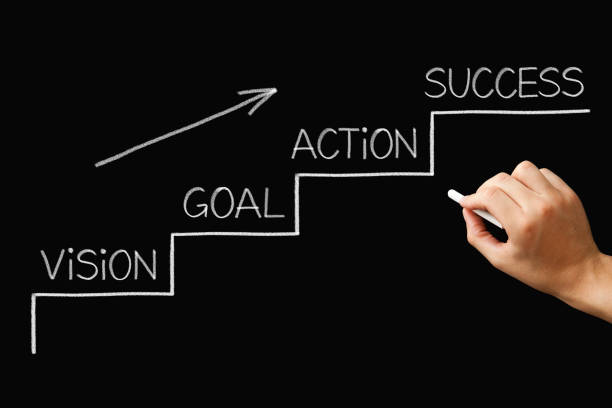
Still, this is where many long-term goals fail: execution. A bold vision can energize a team for a few weeks, but energy fades quickly if people don’t know what to do next. Every meaningful goal must translate into the next physical action. What happens tomorrow morning? What happens this week? What happens today?
Momentum lives in the next step. When the next step is unclear, projects stall and procrastination grows. When the next step is visible, progress becomes tangible and confidence grows. Long-term thinking is not about the distant future, it is about making the future actionable today.
There is also a human dimension that is often overlooked. Long-term goals only work when people feel safe moving toward them together. The best teams don’t avoid conversations; they run on them. Feedback, recognition, and open dialogue keep alignment alive. Without conversation, even the most inspiring goals slowly fade into the background.
And then there is burnout a word that appears in almost every conversation about work today. Many assume big goals cause burnout, but the reality is more nuanced. Burnout rarely comes from challenge itself. It comes from misaligned challenges. People thrive when the difficulty of the work matches their skills and when progress is visible. In those moments, work becomes energizing instead of draining. When clarity matches ambition, people experience purpose.
Long-Term Goals Need Psychological Safety
This matters even more as AI accelerates the pace of work. Technology can automate tasks and optimize workflows, but it still depends on human direction. AI can accelerate progress, but it cannot decide where we should go. In a world of infinite inputs and constant distraction, direction becomes the ultimate competitive advantage.
Throughout my journey building communities and working on human potential, one belief has remained constant: people want to contribute to something meaningful. When long-term goals are clear, individuals feel part of a bigger story. Teams move with shared momentum. Organizations build lasting impact.
Short-term tasks fill your calendar. Long-term goals fill your work with meaning.
The teams that win are not the busiest ones. They are the ones who know where they are going and take the next step every single day. Direction creates momentum. Momentum creates results. And over time, those results change everything.
Long-Term Goals at Work: FAQ
Why do long-term goals matter at work? Long-term goals matter because they sit between two failure modes: speed without direction becomes noise, and direction without action becomes fantasy. A clear long-term goal gives a team a shared future to move toward, which is what turns busy work into meaningful progress. Without it, motivation erodes and decisions become reactive instead of intentional.
Why do teams fail even when they have talent? Teams rarely fail for lack of talent — they fail because they lack a shared future they are moving toward together. When the long-term picture is missing, people stay busy but lose the thread of why their work matters, alignment weakens, and burnout grows. A common direction, not more talent, is usually what’s missing.
How do you turn a long-term goal into real progress? By translating it into the next physical action. A bold vision energizes a team for a few weeks, but momentum lives in the next step: what happens today, this week, tomorrow morning. When the next step is visible, progress becomes tangible; when it’s unclear, projects stall. Long-term thinking is really about making the future actionable today.