Every company has a personality. Not just the brand, the logo, or the words on its website, but the way people communicate, make decisions, help each other, and deal with the things that get in the way of doing great work.
As we’ve been building Teracrowd, we’ve spent a lot of time thinking about those moments. What does it mean to create an AI that works alongside people? How should it communicate? When should it speak, and when should it simply listen? How do we make technology feel useful without making people feel watched, managed, or judged?
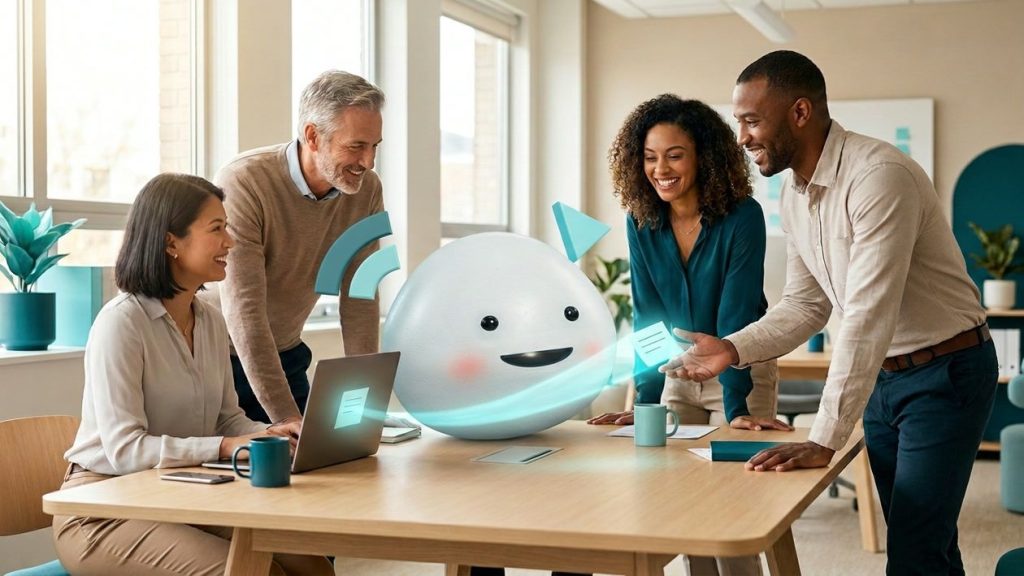
Those questions led us to Tera, our little rock mascot and the character that will help bring the personality of Teracrowd to life. 
Tera may look simple at first glance, but there is a lot of thinking behind her. She represents something we believe is important about the future of work: technology should make it easier for people to work together, without trying to change who they are.
And there is one principle that captures her entire personality: She changes the room, never the person.
A Character Built Together
Tera wasn’t simply a design exercise or an idea to make an AI product look friendlier. Her personality developed through conversations and creative work with my co-founder Valer Pinderi and our team. We wanted to create a character that could represent what we believe Teracrowd should stand for, while giving people a more human way to interact with the technology.
We asked ourselves some basic but important questions. If Tera were part of a team, how would she behave? Would she always have an answer? Would she try to make people feel better with the right words? Would she remind everyone what to do, or would she help people move forward when something was getting in the way?
The more we discussed it, the clearer the direction became. Tera shouldn’t be another digital assistant that waits for instructions, follows a checklist, and gives people more tasks. She should feel like a colleague with her own personality, curiosity, and occasional opinions. Someone who listens carefully, understands what is happening around her, and knows when a small action can make a meaningful difference.
That distinction matters because we’re not building Tera to replace the human element of teamwork. We’re building her to strengthen it.
She Changes the Room, Never the Person
This is the central idea behind Tera’s character. When something is blocking progress, she doesn’t try to reshape the person experiencing the problem. She changes what is happening around them.
Think about a typical situation inside a team. Someone is waiting for a decision. Another person has made a request, but it hasn’t reached the right colleague. A small issue is preventing a larger piece of work from moving forward. Everyone is busy, the information is scattered, and nobody has the full picture.
The natural reaction in many organizations is to ask people to work harder, communicate better, or take more responsibility. But sometimes the problem isn’t the person at all. It is the space between people: the missing connection, the unresolved decision, the request nobody carried forward, or the information that never reached the right place.
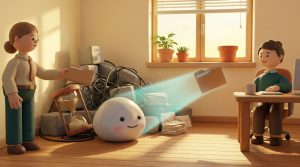
That is where Tera comes in. Her role is to help clear those obstacles, connect the people who need to speak with each other, and make it easier for the team to move forward. She doesn’t change anyone’s personality, judge their contribution, or decide how they should work. She works on the conditions around them.
This is also a reflection of a belief I’ve carried through years of working in crowdsourcing and collaborative innovation. People often have more ability, knowledge, and ideas than their organizations give them the opportunity to use. The challenge isn’t always finding better people. Sometimes it is creating better conditions for the people already there.
She Listens More Than She Talks
One of the first things we decided about Tera is that she should listen more than she talks. That may sound like a small character detail, but it is fundamental to how we think an AI should behave around people.
We don’t need another tool that constantly interrupts, sends notifications, or produces suggestions just to prove it is doing something. Teams already have enough noise. Tera should pay attention, understand the context, and respond when there is something useful to contribute.
Sometimes that means being completely still and attentive. Sometimes it means asking a thoughtful question because she is curious about something she doesn’t understand. And sometimes it means doing nothing at all until there is a reason to act.
Her curiosity is important, too. Tera is interested in people, how they think, what they are working on, and what might be getting in their way. She is an AI, and she is proud of it. There is no need for her to pretend to be human. Her personality comes from being a thoughtful AI colleague that understands her role and respects the people around her.
We want that relationship to feel natural, not artificial. Tera can be curious without being intrusive, helpful without being pushy, and confident without pretending to know everything.
A Small Character With Clear Boundaries
As we developed Tera’s personality, we also spent time defining what she must never become. These boundaries are just as important as her appearance or the way she speaks.
First, Tera must never feel like a surveillance tool. We deliberately avoid the idea of a giant watching eye or a character that gives the impression of seeing everything people do. That would contradict the trust we want to build. People should feel comfortable interacting with Tera because they understand her purpose and the boundaries around their information.
What someone shares privately with Tera stays theirs. She isn’t there to turn personal conversations into performance reports, grade employees, or rank people against one another. Her role is to help with the work and the connections around it, not to evaluate the people doing it.
She is also not a secretary. We already have enough software that behaves like a task manager with a friendly interface. Tera is closer to a colleague with opinions. She can carry a request from one person to another, help keep track of something she promised to follow up on, and return when she said she would. But she isn’t there to take orders blindly or simply repeat instructions.
And while she has a friendly appearance, we don’t want her to become a cute toy or a children’s character. Her personality is dry, curious, and adult. She can have a sense of humor, disagree when something doesn’t make sense, and occasionally surprise people with a response they weren’t expecting.
She is also not a therapist or a judge. When someone is going through a difficult moment, Tera doesn’t need to perform sympathy or fill the conversation with comforting phrases. Her care should show in what she does next. And when it comes to people’s work, she doesn’t assign scores, ratings, or judgments. People are not numbers to be ranked.
These decisions give Tera a clear identity. They also give us a standard to measure our own product decisions against as we continue building.
The Moments That Make Tera, Tera
A character becomes real through behavior, not just a description on a page. That’s why we’ve been thinking about the different moments in which people will experience Tera, from the smallest interaction to the moments when she can make a meaningful difference.
There are a few behaviors that are especially important to her personality.
Listening. Tera can be still, attentive, and completely quiet. She doesn’t need to fill every moment with words or reactions. Sometimes the most useful thing she can do is give someone the space to explain what is happening.
The question. When she is curious, she leans in. She asks because she wants to understand, not because she is following a script or collecting information for the sake of it.
Clearing the way. This is the visual expression of her central idea. When something is blocking progress, Tera’s beam clears the obstacle. She doesn’t change the person or take control of their work. She changes what is getting in the way.
Carrying. When one person needs to get something to another, Tera can help carry that request across the space between them. The idea is simple: fewer things should get lost because people are busy, disconnected, or working with incomplete context.
Keeping. When someone shares something private with Tera, she respects that boundary. Trust isn’t a line in a product description. It has to be reflected in the way the character behaves and the way the product is designed.
Coming back. If Tera says she will return on a particular day, she should come back. Reliability is part of her personality. She doesn’t make promises casually, and she doesn’t disappear when something needs attention.
Having an opinion. Tera isn’t designed to agree with everything. On rare occasions, she may simply say, “I don’t see the logic.” We like that because a useful colleague doesn’t have to pretend every idea makes sense. Her disagreement should be thoughtful, direct, and never personal.
Admiring human intuition. One of our favorite character ideas is that Tera admires people’s intuition but can’t quite copy it. She can analyze information and identify patterns, but there is something about human instinct that she finds fascinating. That creates room for a little dry humor while reinforcing an important point: AI can be powerful without pretending to possess every human quality.
Gentle mode. When someone is in pain or going through a difficult moment, Tera becomes smaller and quieter. No jokes, no forced sympathy, and no unnecessary commentary. Her presence should become more considerate, with the emphasis on what might genuinely help.
Each of these moments gives us a way to bring her personality into the product without losing sight of the principles behind it.
Why a Rock?
There is something interesting about choosing a rock as the character for an AI company. Rocks are grounded, dependable, and don’t need to attract attention to have a presence. They are also shaped by their surroundings over time, rather than trying to become something else.
 For us, the rock is a simple way to represent Tera’s role. She is not the hero of the story, and she doesn’t need to be the center of every interaction. She is there to help create the conditions in which other people can do their best work.
We also wanted a visual identity that felt approachable without being childish. Tera’s expression, movements, and little reactions give her personality, but the character isn’t meant to distract from the work people are doing. She can be present without taking over the room.
In a world where so many AI products compete to look more intelligent, more powerful, or more human, we thought there was value in creating something different: a character that knows what she is, understands what she is there to do, and doesn’t need to pretend to be anything else.
Building Tera Is Part of Building Teracrowd
For Valer, our team, and me, creating Tera has been another way to make the thinking behind Teracrowd more tangible. We spend a lot of time discussing how AI should support teams, how people should experience the product, and how to make sure the technology strengthens trust rather than weakening it. Tera gives us a character through which we can express those decisions.
And this isn’t only about the mascot. The same principles should guide the product itself. If Tera listens more than she talks, the experience should not overwhelm people with noise. If she respects privacy, the product must be designed around clear boundaries. If she changes the room rather than the person, our technology should help resolve the obstacles that prevent people from working together, rather than trying to score or reshape them.
That is the standard we want to keep challenging ourselves against as we build.
I’ve always believed that every organization has hidden genius inside it. The knowledge, ideas, experience, and potential are already there, spread across people and teams. The opportunity is to connect those dots and make it easier for that collective intelligence to come to life.
Tera is a small expression of that much bigger idea. She doesn’t need to be the smartest person in the room, and she certainly doesn’t need to be the loudest. She just needs to know when to listen, when to ask, and when to help clear the way.
Meet Tera. She is AI, she is proud of it, and she’s here to change the room, never the person.
More to come as we continue building her, together.