
If you’ve been asking why you’re unmotivated at work, this is for you: you’re not failing the job the job was built to fail you.
Clearly, something isn’t working with work in the world today. In this article I’ll show what is happening, why now, and how the situation can improve.
I’ve been an entrepreneur for nearly 15 years. I’ve gone through extraordinary challenges a lot of pain, a lot of failures, and a lot of successes. My challenges, like everyone else’s, are big every day. Yet I’ve almost never been unmotivated. I’ve solved the challenges that came at me and become better.
But meanwhile I’ve watched many people around me who don’t even try to solve theirs or who tried and gave up. Until two years ago I blamed them. I thought they were weak or incapable. Now that I’m working on Teracrowd, I’ve had to go deeper into their reasons and their worldview and I’ve understood it’s not their fault at all. It’s the fault of the system they’re part of.
What’s happening to work today
The statistics show clearly that something isn’t working. And it’s so massive that it clearly isn’t an individual problem it’s a system problem. Just a few of the hundreds of statistics out there:
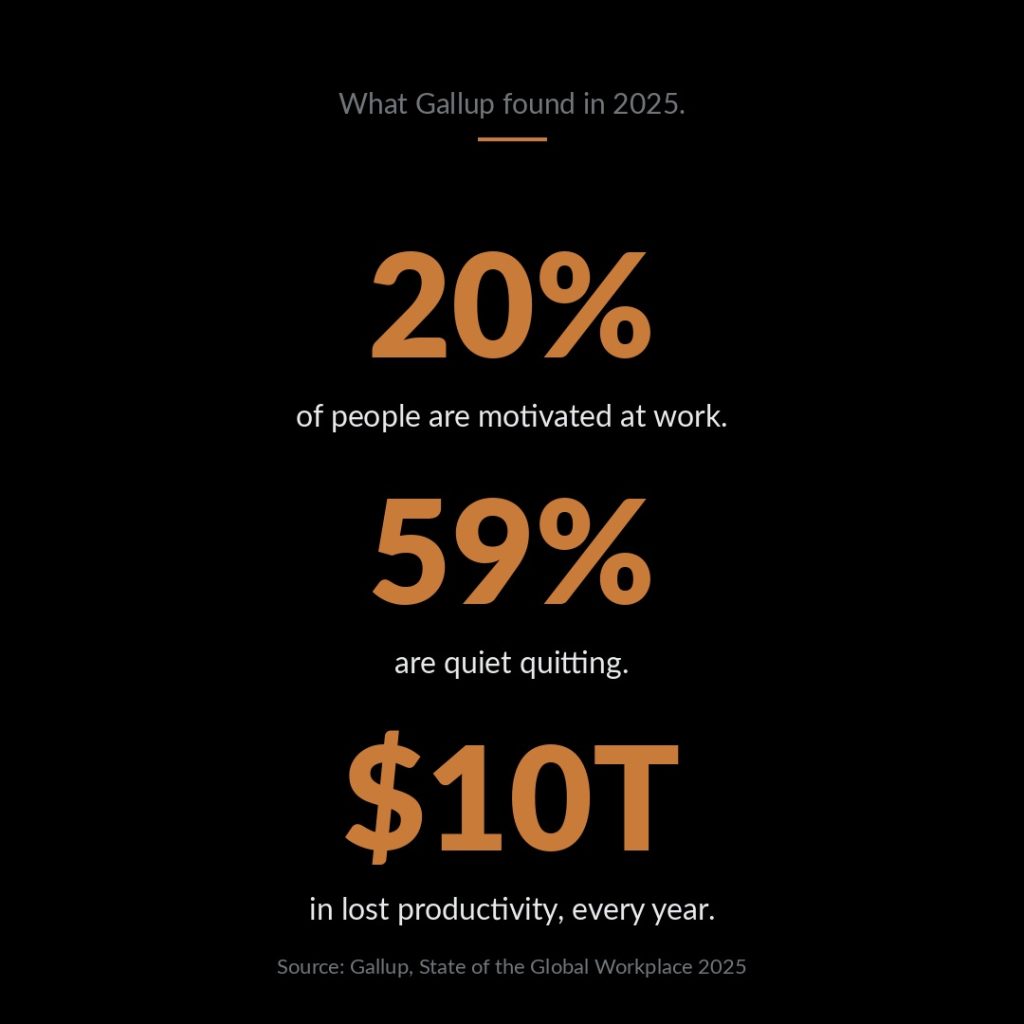
According to Gallup’s State of the Global Workplace 2025, only 20% of people are motivated at work, 59% are quiet quitting. These two numbers alone are costing the world $10 trillion in lost productivity.
Another data point, from 2019: the World Health Organization officially classifies burnout as an “occupational phenomenon” — caused by “chronic workplace stress that has not been successfully managed.” Not a personal disorder. Not a personality trait. An occupational condition.
The studies are endless. But let me come back to what I see around me.
I’m very motivated. Whenever people ask how I’m doing, I tell them I’m great, I feel wonderful. Over 80% of them are surprised by this answer, because they don’t hear it often.
When I talk to people who work, I see two massive forms of dissatisfaction: either they have low pay and are financially unhappy, or they have good pay and are miserable where they are. Of course, not everyone there’s about 20% who don’t fit this classification.
On the other side, I know many entrepreneurs and many HR managers — the very people supposed to change this. They complain that their employees don’t perform, don’t try hard enough, that the tactics they follow don’t work. Many tell me they raise salaries without it influencing performance at all. Many tell me how different employee programs — free gym memberships, food, parties, trips — work for only a few hours, at most a day, and then everything goes back to reality.
Now that I’m in the HR industry, I see that every day a new startup or a new solution comes out for this problem. And every year, the situation gets worse. But why?
What has changed?
Our entire system of work, of education was built for a world that no longer exists. Small improvements don’t affect it. They even make it worse. Reimagining it is the only solution.
The system we’ve built has its origins in 1763. Here are some of the most critical pieces of the system we still live inside today.
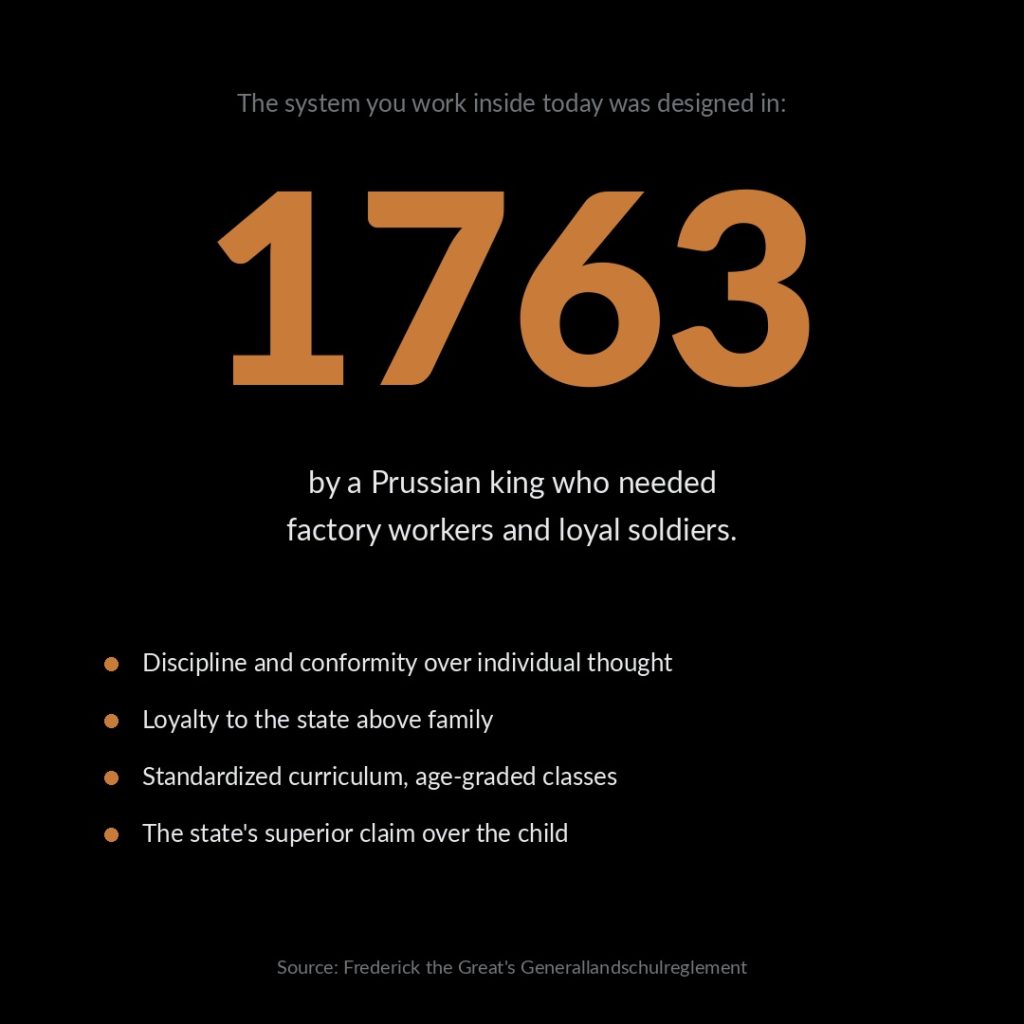
The first piece of our current system was built so that you learned to sit in rows at fixed times because in 1763 a Prussian king needed factory workers and loyal soldiers. The first compulsory schooling system in modern Europe was designed around:
- Discipline and conformity over individual thought
- Loyalty to the state above family
- A standardized national curriculum with fixed subjects, fixed periods, age-graded classes
- The state asserting a “superior claim to the child over the rights of the parents”
The Prussian system literally accelerated industrialization. Historians have shown it made factory workers more efficient. Horace Mann brought it to America in the 1840s, convinced it would create “good, orderly citizens.”
Then, with the rise of factories and large corporations, employers needed a way to quickly evaluate a large number of job applicants. The resume became a standardized tool. That’s the historical record.
In 1882 the modern resume emerged from industrialization. The first job-application letters were called “letters of application” relationship documents. The modern standardized resume appeared in the late 19th and early 20th century specifically because the Industrial Revolution had created large factories that needed to evaluate many candidates fast.
The resume was not invented to help you tell your story.
Then the most impactful element: the job description on your contract was designed by Frederick Taylor in 1911. He designed it so the factory could replace you faster.
Frederick Winslow Taylor’s 1911 book The Principles of Scientific Management established:
- Time-and-motion studies to break work into measurable units
- Standardized job descriptions to make workers interchangeable
- Performance metrics tied to incentive pay the ancestor of the performance review
- Workers explicitly treated as “tools that businesses could deploy to generate profit”
Direct from the historical record: “Taylorism required dedicated staff to conduct time-and-motion studies, standardize job descriptions, and match workers to their tasks.” The job description wasn’t invented to describe a job. It was invented to make you replaceable.
Then HR was built to keep records. The day a department whose original mandate was “payroll and compliance” became responsible for your “engagement” was the day the system was lying to itself.
National Cash Register (NCR) established the first formal personnel department in the early 1900s. Between 1900 and 1920, “welfare work” formalized into “Personnel Departments” across major corporations. Their original functions:
- Payroll
- Employee records
- Labor relations and compliance
Not employee well-being. Not motivation. Not human development. Administration and control.
What changed and why you feel unmotivated at work
Then the microprocessor was invented, and it brought computers to life. From a stable period of development, we entered an exponential one. But computers and AI are no longer the exclusive property of companies today every person can access them.
Gradually, and especially during the pandemic, people started to feel and understand that this no longer works. The pandemic was a wake-up call. With each person’s life at risk, people began to think about what really had value for them. They started to sense the problem, even when they couldn’t articulate it. Gradually that became quiet quitting and disengagement.
Now people are aware they aren’t machines to be put to work with strict processes and job descriptions that treat them as machines. But this isn’t an easy process to understand. Just like I did, before I went deep into this industry judging and blaming the employees, most people are doing the same, from both sides of the problem.
Employees blame HR and the leaders. The leaders blame the employees. Both sides have their problems, but the solution can’t come from the employees. It has to come from HR and leaders, whose job it is to actually understand the situation.
The solution: Treat people as individuals, not resumes
The solution isn’t hard to understand. It’s hard to implement.
We all know an individual isn’t a box that can be summed up in a resume or a job description. An individual is a complexity of aspects that make them unique. No two people are the same so a job description that pretends to define their behavior, and an HR filter that screens by resume, cannot improve the system.
We, today’s leaders, have to treat people as the complex beings they are where the human element is the most important. Culture, mindset, their goals, their style of doing things, and their understanding are more important than experience.
In a world where we have to rediscover ourselves periodically, and re-dimension ourselves periodically with the list of skills we have, experience is the least important aspect. Today we have tools to learn anything fast and any experience, if handled the right way, can help us adapt and perform well.
This doesn’t mean I can be an experienced HR manager without having experience in HR. But if my 15 years as a company leader are understood and treated the right way, my relationship with people in a field like HR can upgrade more easily than if I’m treated as a beginner being taught the basics of dealing with people.
The same is true for someone who has programmed in JavaScript with a hobby in music. They can adapt very easily if this is taken into consideration to become a prompt engineer for the new AI systems that create music. There are as many examples as there are people in the job market.
But doing this isn’t easy, because no leader can know every field. So for the solution we have to look to Artificial Intelligence.
This technology will never replace humans or their importance in judging, prioritizing, or deciding to do something. It can replace a process or a task. But our job isn’t the process or the task our job is the final result. And as long as those results are defined by us, they cannot be replaced by anyone.
This is one of the fields we’re working on at Teracrowd. We know people are unique. They are geniuses, if the right conditions are applied to them. For this we’re using extraordinary computing power to analyze the complexity of each individual, giving clarity on the alternatives they have both for them and for their managers. These alternatives then have to be analyzed, chosen, or changed by people, who, with their originality, give them the form that matters to us as humans.
We didn’t build the system for human resources. We built it for people. The individual is the center of our entire system, designed to create a productive collaboration environment. Everything starts and revolves around the individual, not the company. Companies are secondary. Individuals are primary.
That’s why we’ve decided to start from how an individual works in this moment. And that way isn’t rigid it evolves and transforms after every interaction the individual has with the world. So does our system.
I’m using the same approach in my own life, without AI. I start by understanding who I am and what I care about. Then I start looking outside for what to do or what tools to use. You can do the same thing and immediately you’ll start to understand the aspects that motivate or demotivate you at work, where you’ll need to make exclusive decisions that no tool, no company, and no leader in the world can make for you. Only you can.
Why Work Feels Broken: FAQ
Why do I feel unmotivated at work? Feeling unmotivated at work is usually not a personal failing. Many people are either underpaid and unhappy, or well-paid and quietly miserable. The real cause is most often the system around them — jobs defined by rigid descriptions, and people reduced to a resume — not a lack of effort or ability. If the environment doesn’t fit who you are, motivation fades no matter how hard you try.
Is it my fault that I’m not performing at work? Usually not. Raises, perks, gym memberships, and team events rarely fix disengagement, because they don’t address the real problem: a workplace that ignores who a person actually is — their culture, mindset, goals, and way of working. The fix has to come from leaders and how work is designed, not from blaming the individual.
What’s the real solution to a broken workplace? Treating people as the complex individuals they are, instead of a resume or a job description. When the environment fits the person — their values, goals, and style of working — their potential surfaces. That’s what Teracrowd is built around: starting from how each individual actually works right now, and designing collaboration around the person rather than the org chart.