
This is the case for screening without a resume, and how I learned to hire better by ignoring it.
It seems like everyone has understood that the resume isn’t worth much anymore but no one manages to avoid it. I did it without realizing, before I entered this industry, and only now that I’m inside it do I understand why it always worked for me.
In this article I’ll tell you why I stopped searching with resumes, what I learned among professionals, why the resume isn’t worth much anymore, and finally how to do it without one.
First, some context on my point of view. In 2011 I became a CEO with no prior experience managing people, in a small country, in the e-commerce industry while the market was far behind in this field. I was its pioneer: the first serious company in the industry. I started the company alone, and whenever I got overloaded with work, I’d recruit the next person. My first hires were mostly students. Within a few years I grew, and I started taking in investment. When I finally had the budget to hire experts, I realized there were none in the industry I was in. So experience didn’t help me much. In fact, I noticed that people with a lot of experience in traditional retail sales created problems for me, because they couldn’t easily change the method they had locked into from that industry which was different from what I was doing.
So again I started to ignore the resume and focus on the people: who was curious to learn a new field. I wasn’t looking for specific skills, I was looking for the needs people had. I was looking for character and only once I found it did I start asking what skills they had.

After a few more years I made an exit to a big corporation. That’s when I brought HR into the company, and there the process got standardized around resumes and job description. Later I realized the situation was getting worse: I kept talking to more and more unsuitable people. The problem was that I’m not a very intuitive person, so when the resume validated someone, I accepted them but a few months later I would feel the cost it had taken from me, until I finally figured out where the problem was.
One person wrote to me on my social media and said: “Valer, I want to meet you. I applied to you but wasn’t accepted still, I wanted to work for free for you, to prove I’m good and that I want to grow.” Of course I couldn’t ignore that message, and I took that person into an interview. When I finished, I called HR and asked why he hadn’t been called for an interview. They told me he didn’t meet the criteria. She was right but I understood that the problem wasn’t HR, it was the process we had put in place. Experience doesn’t show who you are. And if we want to hire people for their character, the resume is just a distraction from the truth.
What I learned among professionals
For two years now I’ve completely changed direction. Just like e-commerce was at my beginnings, now it’s artificial intelligence. So I can’t be afraid of it I’ve been through this before, and I know how important the coming years will be. Right now I’m building Teracrowd, a tool to help people perform and feel better at work. Here I realized this is also the thing I love doing: understanding human nature and contributing to a better work environment is something I’ll do for the rest of my life.
But I come with a sense of unease about the way things are now, where only 20% of people are motivated at work and 59% in the USA are quiet quitting. That shows, with facts, that something is wrong in the workplace. So I look at today’s procedures with skepticism and with the ambition of a beginner who wants to disrupt a system that has been built over years.
Still, I had to go deep into what really happens. First, during my many interviews with recruiters, I saw that most of them give the resume only a few seconds yet it’s the first filter for deciding who gets more attention. Others give the resume so much weight that they disqualify over 90% of candidates from it alone. Meanwhile, the largest study on what connects selection criteria to someone’s job performance shows that experience and education affect that performance by about 1%, while a conversation affects it by about 20%. That’s the Schmidt & Hunter (1998) study. Based on these numbers, it’s clear why recruiters and everyone else hate the resume, and yet everyone keeps using it to start the selection process.
Why everyone uses the resume, and why no one likes it
HR as a department has evolved since its beginnings, and it keeps transforming. In today’s situation we have to keep in mind that we have companies with hundreds or thousands of people, and with the limited capacity we had before AI, it was impossible for a human being to manage all of this without a Job Description and without a resume. Still, these created negative consequences too which I see as the starting point of the main problem we have with motivation at work today.
Trying to manage the situation, HR puts people in boxes and categorizes them. This damages human nature, which is so complex and so diverse that it’s hard to find two twins who are the same and even genetically identical ones aren’t. So imagine categorizing and putting all people into one box.
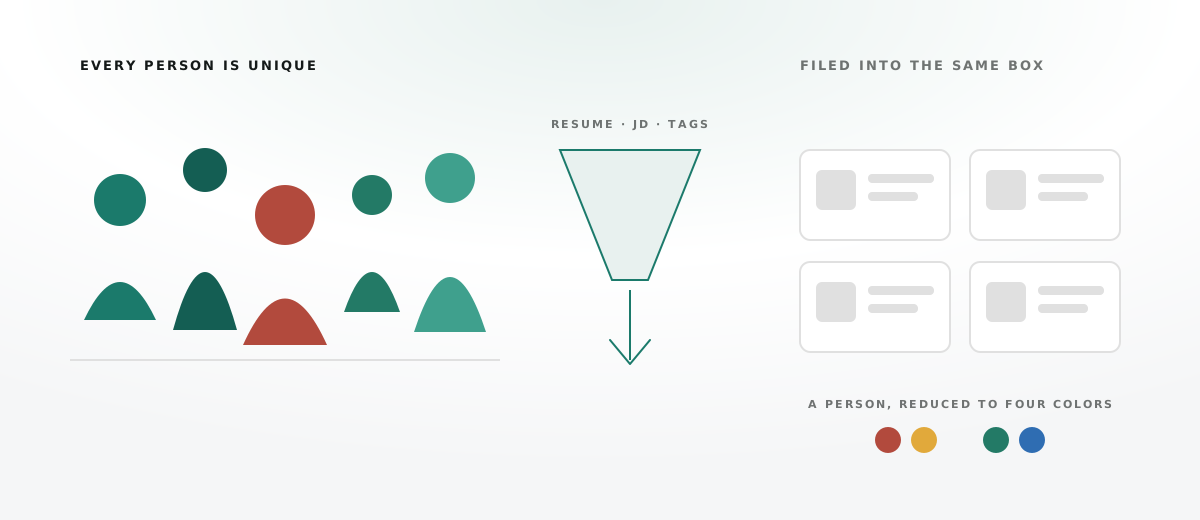
Take the simplest case: the salesperson. There are so many types of salespeople and sales behaviors, yet as people we can’t seem to consider them as more than B2B, B2C, or B2G. We can split them corporation vs startup, and a few other divisions. But inside there are hundreds of styles, ways, and aspects of selling that these limits don’t take into account. So we settle, out of necessity, for the most general version without being able to address the uniqueness of human nature.
The big HR companies like Workday, or the various ATS like Greenhouse, unable to completely revolutionize this method, are now automating the very thing that hasn’t worked and has been the problem until now. They scale up the boxing of people with tags pulled from the CV, with the automation of job descriptions tied to evaluation, and all those processes that strip a person of their originality. And to solve for large volumes, HR has come up with interviews that ask the same questions to everyone which again puts people in boxes and again the established HR companies automate this part, making the situation worse.
Even for the most ambitious ones, it’s impossible to consider every applicant and interview them personally, entering their unique world. No one has time to talk to 100 applicants for one job opening. But this is exactly where the solution we’re trying to build lies.
How to screen candidates without a resume
On one thing we all agree: the resume doesn’t work. But what’s the solution?
After two years of work, focused on the techniques that can now be implemented with the computing power and intelligence we have, we decided to replicate the most important technology people have ever invented “the conversation”. Our system speaks, by voice, with people without a script, but connected in a unique way to each individual and it draws out how they work and what motivates them.
We don’t assign them types or colors the way the DISC profile does, because those are again just limitations people have used to understand someone not the reality of people, who don’t divide into 4 colors. Every person who talks with our system has their own uniqueness, in every aspect.
With this in mind and believing that everyone is a genius we created a feature that first takes the human aspects of a job from the team leader, and then analyzes how well they match the candidate, again in an organic conversation without a script. With our system you can now have a conversation with each of your candidates and pull out the unique aspects you’re looking for in your job. Then, with the ones who fit your approach, you can do a personal interview where you spend even more time because that time has been saved from the whole earlier process.
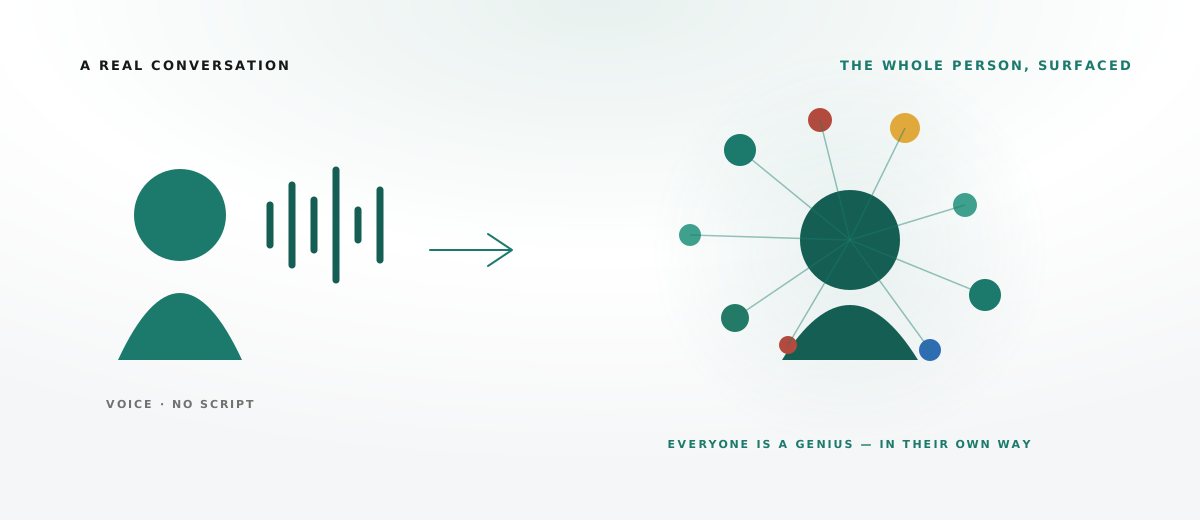
Many AI interview systems are unproductive because they use a script and don’t know human nature the way we do. We saw this when we ran our first analysis: over 90% of the people who interview with Tera feel just as good, or even better, than they would with a human. Because they are heard for what makes them valuable, and valued for what they’re good at and only then are they compared against the aspects someone is looking for.
This does what should happen every time someone starts a job. If the environment isn’t right for both sides, and in line with their genius, it’s better not to work together in the first place than to work together and damage the whole process. It does what I used to do when we were a small company talk to everyone, understand their genius, and check whether it matched the need we had at that moment.
For us, this is only the beginning of changing the way HR manages people the most important asset in a company, where each one has their own genius and their own uniqueness, as a unique, living individual, today.
Screening Without a Resume: FAQ
Why screen a candidate without a resume? Because the resume can’t show how a person actually works their curiosity, adaptability, and fit for the specific role. In this founder’s experience, highly “experienced” hires often underperformed because they were locked into old methods, while the resume gave no warning of that. Screening through conversation surfaces the qualities a resume hides.
Why does everyone still use the resume if it doesn’t work? Mostly out of necessity at scale. There’s no easy way to understand every applicant’s uniqueness, so companies settle for the resume’s generic version. Big HR platforms like Workday and ATS tools like Greenhouse then automate that broken method — scaling the “boxing” of people by resume tags and scripted, identical interviews instead of fixing the underlying problem.
QHow do you screen candidates without a resume? Start from the human aspects of the role, defined by the team leader, then have an organic, unscripted conversation with each candidate to draw out the qualities the role actually needs. Only the people who genuinely fit move to a personal interview and you have more time for it, because the early screening no longer burns hours on resumes. That’s how Teracrowd’s screening works.