The Chief of Staff is becoming one of the most interesting roles in modern business. As organizations grow more complex, leaders need someone who can connect the dots between strategy, people, priorities, and execution. Someone who understands not just what is happening, but why it matters, what is getting in the way, and where attention can make the biggest difference.
Traditionally, this capability has been reserved for the top of the organization. A CEO gets a Chief of Staff to maintain context, connect teams, and make sure important decisions don’t disappear beneath the weight of daily operations. At its best, the role isn’t about managing calendars or chasing action items. It’s about helping a leader see the bigger picture and create the conditions for people to do their best work.
Having spent years exploring crowdsourcing, collaboration, and how organizations unlock human potential, I’ve seen the same challenge repeat itself: companies have more talent and information than ever, yet struggle to bring the two together when it matters most.
So here’s the question: what happens when every team gets the benefit of a Chief of Staff?
The Problem Isn’t a Lack of Tools. It’s a Lack of Context.
Companies have invested heavily in project management platforms, CRMs, collaboration software, dashboards, and AI assistants. Yet managers still spend their days chasing updates, resolving misunderstandings, and figuring out why work that looked fine on Monday is suddenly stuck on Thursday.
Information isn’t understanding. A project tool can tell you a deadline has slipped, but not that someone has been waiting six days for a decision. A meeting summary can capture what was said, but not that two people left with completely different interpretations. A dashboard can show a problem without revealing the human or organizational obstacle behind it.
As companies grow, these gaps become more expensive. Every new person adds capacity, but also creates more conversations, dependencies, and decisions to coordinate. The team gets bigger, but keeping everyone aligned becomes harder.
The irony is that we hire talented people for their intelligence, experience, and initiative, then build working environments that make them increasingly dependent on someone else’s attention.
When the Manager Becomes the Bottleneck
Consider a manager with twelve direct reports. Even if they could have a meaningful conversation with every person each week, those twelve conversations are only the beginning. They still have customers, planning, hiring, reporting, and decisions to make. No manager can hold every detail, dependency, and emerging problem in their head.

So the manager becomes the human operating system. Questions flow upward, decisions wait for approval, and people learn that the safest way to move forward is to ask first. Instead of unlocking the team’s collective intelligence, the manager ends up coordinating work that capable people could often move forward themselves.
This isn’t necessarily a failure of leadership. It’s a structural problem. We’ve asked managers to maintain more context than one person can reasonably hold, then tried to solve it with more meetings, more reporting, and more tools.
What if the answer were to give people the context and confidence to act without constantly waiting for permission?
AI Can Democratize the Chief of Staff
Until recently, the support of an effective Chief of Staff was expensive and usually reserved for senior executives. AI creates an opportunity to extend that capability to managers and teams that could never justify hiring someone for the role.
But the real opportunity isn’t automating administrative work. It’s helping teams understand what is happening across their work, retain lessons from experience, and connect signals that would otherwise remain scattered across conversations.
Imagine knowing that a project isn’t behind because the team is underperforming, but because a decision is waiting on you. Imagine spotting a misunderstanding before it affects a customer, or helping someone find the clarity to move forward without scheduling another meeting.
This is where AI can make a meaningful difference: not just helping individuals produce more, but helping people collaborate, solve problems, and innovate together.
From a Chief of Staff for One Leader to One for the Team
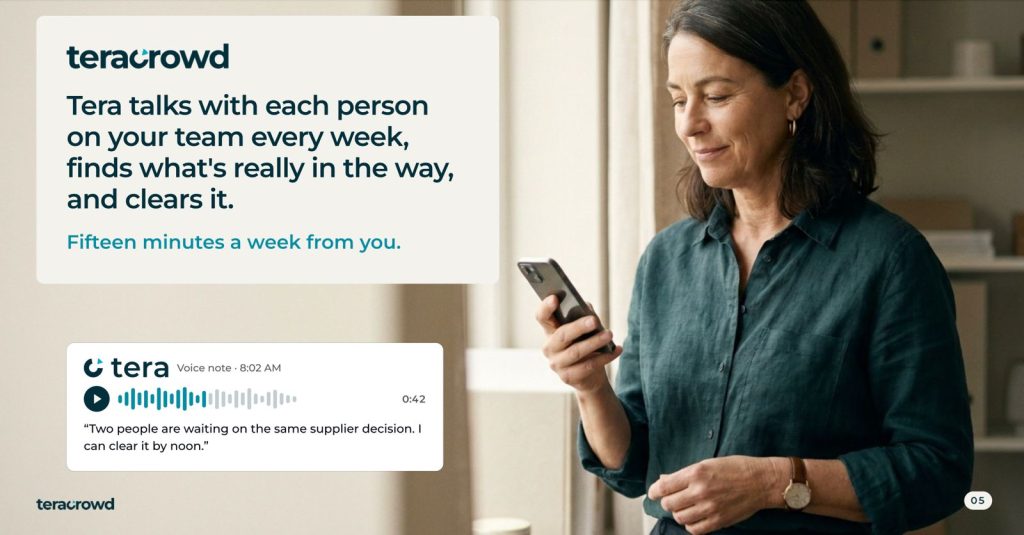
At Teracrowd, we’re building Tera around this idea: an AI Chief of Staff for your team. Tera talks with team members, helps uncover what’s getting in the way, and brings forward the context needed to clear it.
The goal isn’t to monitor people or turn conversations into performance scores. It’s to help managers understand where work stands, where progress is blocked, and where their judgment or support can make a difference. At the same time, team members get more room to solve problems and make decisions themselves.
That distinction matters. Teams don’t need another system watching every move. They need an intelligence layer that helps people retain context, resolve friction, and move forward. Managers remain responsible for the decisions that require experience, coaching, accountability, and human judgment. AI helps get the right context to the right person at the right moment.
You can explore what we’re building at Teracrowd.
The Future of Management Is More Human
I’ve always believed that the intelligence an organization needs is already inside its people. The challenge is creating the conditions for that intelligence to surface, connect, and become collective progress.
AI should help us do exactly that. Not replace the conversations that build trust, but make them more meaningful. Not give managers more control, but give them more capacity to lead. Not make people more dependent on systems, but help them become more confident and capable of moving forward together.
The Chief of Staff has always helped leaders see the bigger picture and focus their attention where it matters most. AI gives us the opportunity to bring that principle beyond the executive suite.
The next evolution of the Chief of Staff may not be another person sitting beside the CEO. It may be an AI that helps every team unlock its collective intelligence, and gives every manager more time to lead.